The development of mobile apps is no longer a frivolous spending of modern business seeking to go digital. Nevertheless, it can be quite costly to develop native applications on Android and iOS separately, and the development process may last longer and be accompanied by complicated maintenance issues.
It is into this platform that cross platform mobile app development has come in as a viable and future-proof solution. Allowing developers to develop applications on the basis of the same codebase allows businesses to save time-to-market and ensure similar functionality across platforms.
With the growing competition in the global markets such as the USA, UK, Australia and Canada, it is no longer a question but a requirement to adopt cross-platform strategy.
What Is Cross Platform Mobile App Development?
Cross platform mobile app development is a type of development process that enables applications to be used in different operating systems with the use of common source code. Rather than developing native applications isolatedly, developers use cross-platform frameworks to assemble or bridge code with high efficiency.
This approach makes the development lifecycle much easier and provides a way of delivering mobile applications at a quicker pace without compromising on usability or performance.
Why Cross Platform Mobile App Development Matters in 2026
By 2026, companies are supposed to introduce digital products with more speed and at cost-efficient and scalable prices. Cross-platform development serves the purposes of these objectives directly by decreasing redundancy and enhancing operational agility.
The main advantages of business using cross-platform solutions are:
Cross platform mobile app development allows organizations to reduce overall development costs by maintaining a single shared codebase instead of hiring separate Android and iOS teams.
Businesses can reach a broader audience simultaneously across Android and iOS platforms, improving brand visibility and accelerating user acquisition globally.
Platform consistency in user interfaces will improve customer relationships, brand recognition and reduce the long term maintenance of applications.
Native App Development vs Cross Platform App Development
Native and cross-platform development debate is still a controversial topic, yet the contemporary frameworks have helped reduce the performance and usability gap to a minimum.
Parameter
Native Apps
Cross Platform Apps
Cost
High due to separate development
Lower due to shared code
Code Reusability
Platform-specific
Single reusable codebase
Development Speed
Slower
Faster and more efficient
Maintenance
Complex
Simplified and centralized
Performance
Fully optimized
Near-native with modern frameworks
The native development emphasizes performance specific to the platform whereas the cross platform mobile application development emphasizes efficiency, scalability and optimization of costs.
Challenges in Cross Platform Mobile App Development
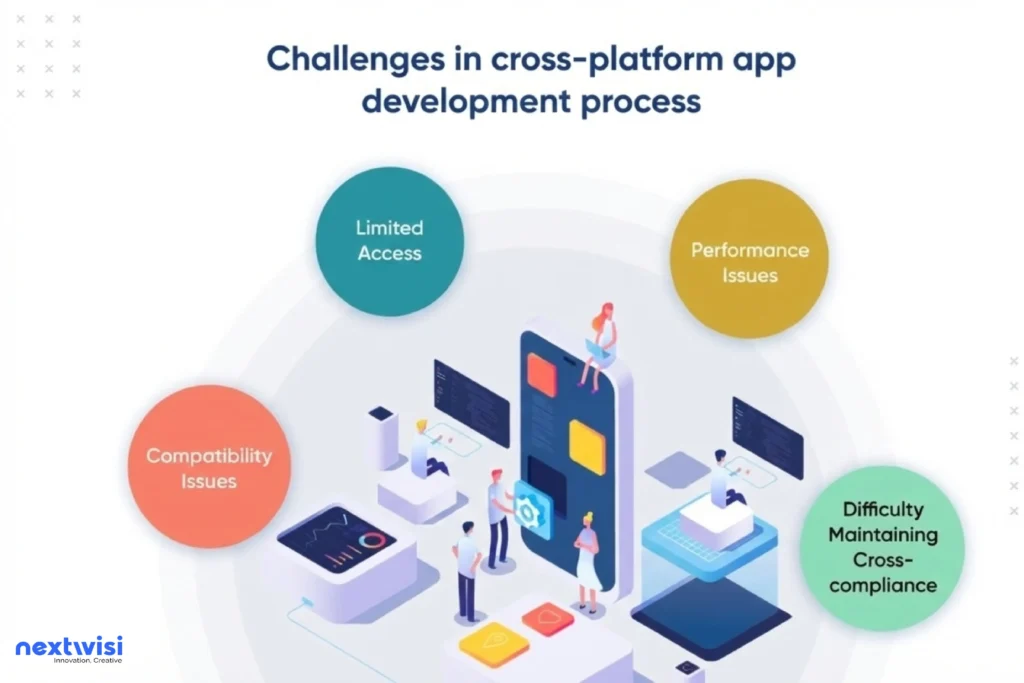
Cross-platform development has a number of technical and operational issues that should be considered carefully even despite its benefits.
Key Challenges Include:
The different operating systems, screen sizes, and hardware configurations might pose compatibility problems that will need a considerable amount of testing in different environments as well as different devices.
Functional constraints may be caused by limited access to hardware-specific features, particularly when an application needs deep integrations through the OS.
This can be caused by performance bottlenecks when abstraction layers exist between native and non-native components and are especially pronounced in graphics intensive or real-time applications.
It may be challenging to keep up with the regular updates of operating systems, since structures will always have to adjust to be compatible and fixed.
Though these are the challenges, they are very minimal compared with the long-term advantages of cross platform development.
Advantages of Cross Platform Mobile App Development
The popularity of cross-platform development has been increasing due to its apparent business and technical benefits.
Major Benefits Include:
A cross platform mobile app development allows a business to exploit maximum audience reach by implementing the application on Android, iOS and web platform using a single application.
Lower cost of development and operation assists startups and enterprises to distribute budgets fairly in their efforts to avoid undermining the quality of applications or scalability.
Shortened development cycles enable organizations to introduce products at a faster pace, react to market dynamics, and be competitive in swiftly changing digital landscapes.
Maintenance is simplified such that updates, bug fixes, and improvements are not copied in the efforts to maintain two or more platforms.
Code reusability reduces duplication of development efforts, is time saving, resource saving and maintenance cost saving in the long run.
The continuous integration of the cloud offers portability, data synchronization and protection, inter-platform and inter-devices.
Similar UI and UX enhance familiarity, engagement, and satisfaction to the user no matter the operating system.
Programming Languages and Cross Platform Frameworks
Programming Language
Cross Platform Frameworks
JavaScript
React Native, Ionic, NativeScript
Dart
Flutter
C#
Xamarin
Java
Codename One
Python
Kivy, BeeWare
Best Cross Platform Mobile App Development Frameworks in 2026
1. Xamarin
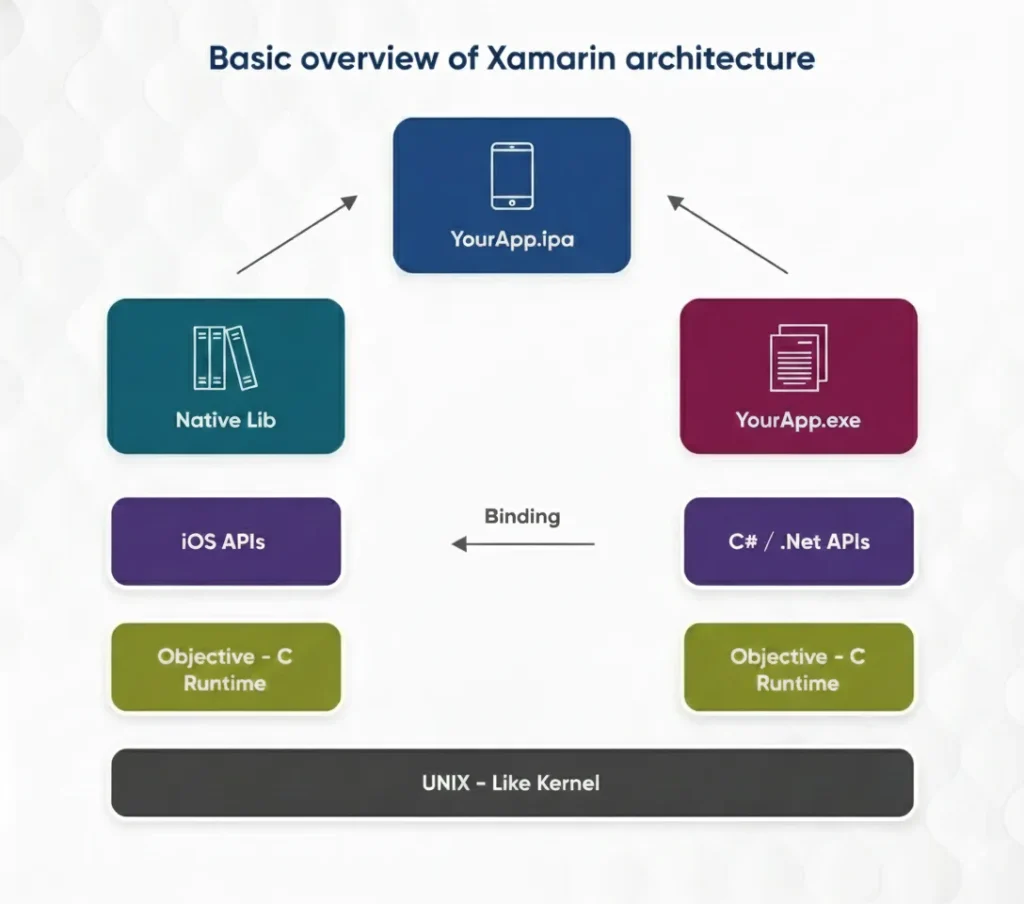
Xamarin which is supported by Microsoft is written in C# and.NET, offering application development capability of enterprise scale, and with great code-sharing.
Pros of Xamarin:
Xamarin allows developers to reuse a large chunk of application code across platforms, shortening development time and allowing high performance and stability.
On the one hand, Xamarin is especially appropriate in large enterprises and in complex ecosystems of applications because of integration with Microsoft tools and cloud services.
Cons of Xamarin:
Enterprise use The cost of licensing may be expensive and it is not suitable to start-ups or projects with very limited financial resources.
Native development might be necessary to provide an excellent user experience with applications of high UI or graphics.
2. React Native
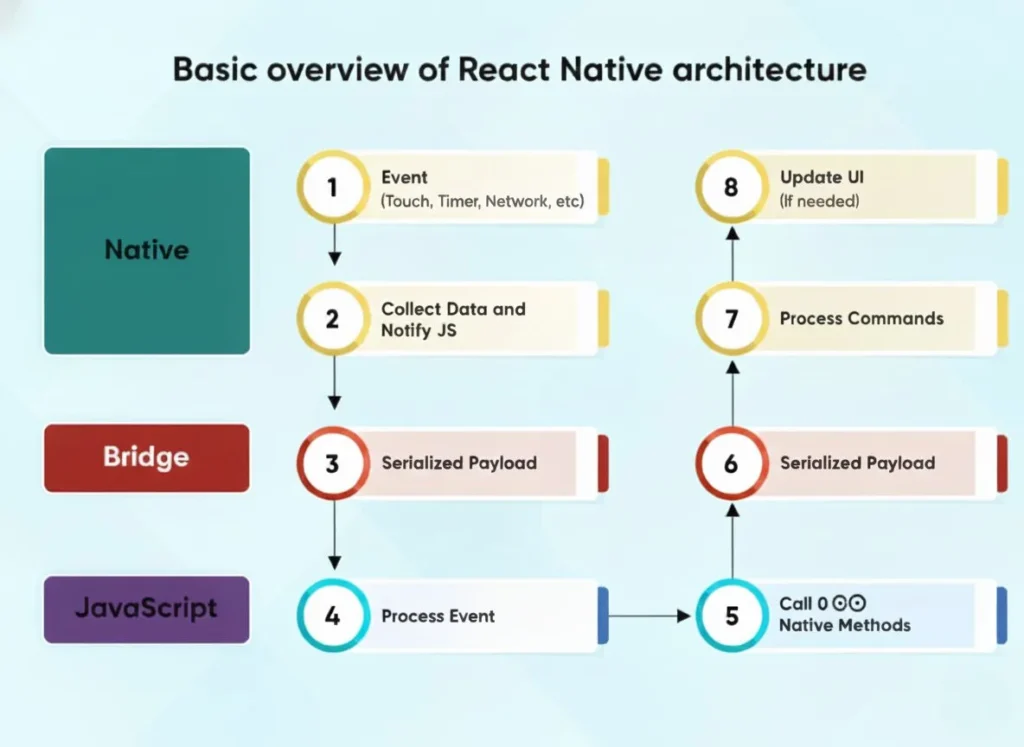
React Native is an app development technology that is still popular because of its flexibility, JavaScript framework, and a strong developer community.
Pros of React Native:
React Native makes development faster and easier since developers can view changes in real-time with the use of hot reloading and save a lot of time during iteration.
Big open-source ecosystem offers wide range of libraries, plugins and community support in solving problems more quickly.
Cons of React Native:
There are still some high-level features that cannot be implemented in software; this brings complexity to applications that need specialized hardware.
Depending on the Android devices and complicated user interfaces, debugging may be time consuming.
3. Flutter
Flutter has received substantial uptake because it has a widget-based design and has a consistent way of rendering its UI.
Pros of Flutter:
Flutter is based on one rendering platform, which makes it uniform to design and provides smooth animations on all platforms without depending on native elements.
It is perfect in the case of MVP as it ensures that business ideas can be more rapidly validated with less cost of development.
Cons of Flutter:
Flutter applications are also likely to have higher file sizes than native ones, which can affect the speed of downloading.
Lack of support on non-mobile platforms such as the Android TV and Apple TV is also a weakness.
How to Choose the Right Cross Platform Framework
The choice of the proper framework is related to the technical needs of your project, the time frame, and the long-term objectives.
Important Factors to Consider:
The expertise of the development team is also essential, since its knowledge of certain frameworks directly affects its productivity and quality of use.
The requirement of the framework of learning curve, tooling, and maintenance should be aligned with the budget constraints and delivery timelines.
One of the areas that should be considered is the performance expectation and scalability requirements particularly of enterprise or data-intensive applications.
Best Practices for Cross Platform Mobile App Development
Ensuring consistency of UI across platforms with predefined system of design enhances the usability and a foreseeable user experience.
Near-native responsiveness can be reached through optimization of application performance, by reducing the unneeded abstraction levels.
Clean, modular and testable code writing enhances maintainability and minimizes technical debt in the longer-term.
Thorough testing on devices, screen size, and operating systems will make sure there is reliability on the application before deployment.
Future of Cross Platform Mobile App Development
Emerging technologies and changing business demands are the forces behind the cross platform mobile app development in the future.
Key Trends Shaping the Future:
The artificial intelligence will be used to improve personalization and automated testing and predictive analytics in cross-platform applications.
The integration of the Internet of Things will support the flow of communication between mobile applications and connected devices across the industries.
Low-code and no-code will provide a faster way to develop and enable solutions to cross-platforms to be used by non-technical people.
Cloud-native architecture will enhance security, scaling, and performance with lowering complexity of infrastructure.
Conclusion
Cross platform development has been seen to be more than just a cost-saving option , it has become a strategic advantage to contemporary business. As cross platform mobile app development frameworks such as Flutter, React Native and Xamarin mature at an alarming rate, cross platform development allows developers to launch faster, save money, and maintain uniform digital experiences.
The selection of the appropriate framework will be based on the objectives of the business, technical needs and scaling purposes. By cooperating with an established cross-platform mobile application development firm, the informed decision-making will be guaranteed and make the venture a success in the long run.