By admin
2/19/2026
In today’s mobile-driven economy, enterprises can no longer rely only on traditional desktop software or fragmented digital tools. Employees, managers, and customers now expect instant access to systems, real-time updates, and seamless digital experiences. This is where enterprise mobile app development becomes a strategic investment rather than just a technology upgrade.
From improving internal productivity to enabling smarter customer engagement, enterprise mobile application development helps organizations build secure, scalable, and high-performing mobile solutions tailored to complex business workflows. As companies adopt enterprise mobility and digital transformation strategies, mobile-first systems are becoming the backbone of modern business operations.
This guide explores what enterprise mobile app development is, why enterprises are adopting it, key app types, core features, development processes, costs, security considerations, and future trends shaping the enterprise digital ecosystem.
Enterprise mobile app development refers to the creation of custom mobile applications designed specifically for large organizations and business operations. Unlike consumer apps built for entertainment or social interaction, enterprise apps focus on productivity, workflow automation, and system integration.
These applications are connected to enterprise backend systems such as ERP, CRM, cloud platforms, and internal databases. They are built to handle large volumes of users, complex business logic, and high data security requirements.
In simple terms, enterprise app development transforms traditional enterprise software into mobile-enabled tools that employees and managers can access anytime, anywhere. This supports enterprise digital transformation by shifting business processes into a connected, mobile-friendly environment.
Organizations are rapidly adopting enterprise mobility solutions because modern workforces are no longer limited to office desks. Teams work remotely, operate in the field, and collaborate across geographies.
Mobile-first enterprise systems help businesses achieve:
A well-designed enterprise mobility strategy ensures that critical business processes are available through secure, scalable mobile platforms that support continuous growth.
Many enterprises struggle with outdated systems, disconnected tools, and manual operations. Enterprise mobile apps directly address these challenges:
Automated approvals, digital forms, and real-time notifications reduce bottlenecks and speed up operations.
Mobile apps integrated with enterprise backend systems unify data across departments into centralized systems.
Enterprise software solutions improve collaboration through shared dashboards, messaging, and task coordination.
Business intelligence mobile apps provide real-time analytics, enabling data-driven decisions.
By solving these issues, enterprise mobile app development increases operational efficiency and long-term scalability.
Different enterprise needs require different app categories. The most common types include:
These apps focus on workforce management, attendance tracking, task updates, and internal communication. They improve individual efficiency and reduce administrative workload.
CRM mobile applications allow sales teams to access customer data, manage leads, and update deal status in real time. This strengthens customer relationships and accelerates sales cycles.
ERP mobile apps integrate finance, inventory, HR, and procurement systems into a single platform. They enable managers to monitor operations and approve workflows remotely.
BI mobile apps convert complex enterprise data into visual dashboards and reports. Leaders can track KPIs, detect trends, and adjust strategies instantly.
These applications support secure document storage, version control, and collaboration across distributed teams using cloud-based enterprise apps.
Successful enterprise applications are defined by robust features that ensure security, performance, and usability.
Enterprise security solutions include data encryption, multi-factor authentication, secure APIs, and role-based access control. These features protect enterprise data and help meet enterprise compliance standards.
Enterprise app architecture must support growing users, higher data loads, and evolving business needs without performance loss.
Seamless integration with ERP, CRM, and cloud platforms ensures smooth synchronization and real-time updates.
Offline mode enables uninterrupted app usage in low-connectivity environments, supporting field operations and remote work.
Cross-platform enterprise apps ensure compatibility across Android, iOS, and tablets, increasing accessibility.
Enterprise mobile UX/UI focuses on simplicity, clarity, and usability so employees can work efficiently without technical complexity.
The development of enterprise mobile applications follows a structured and strategic approach.
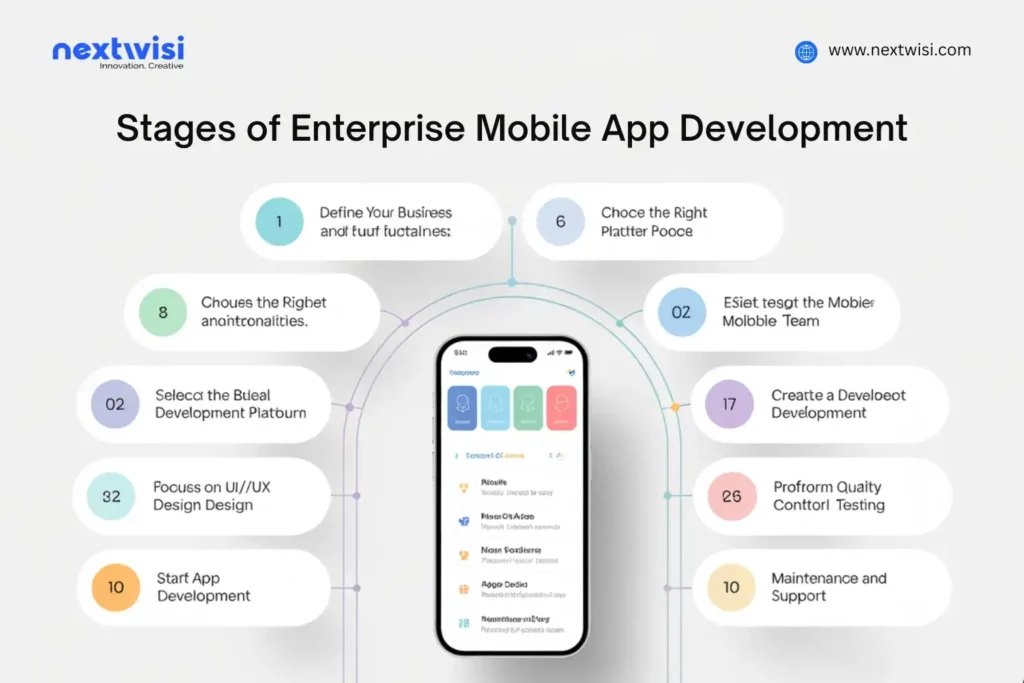
This phase defines business goals, workflows, and user roles. Developers study enterprise systems and identify functional needs.
Designing enterprise app architecture involves selecting platforms, databases, APIs, and cloud infrastructure.
Designers create intuitive interfaces that align with enterprise workflows and branding.
Enterprise backend systems are connected using secure APIs for data synchronization and automation.
Apps undergo performance testing, security audits, and usability testing to ensure reliability.
Post-launch support includes updates, security patches, performance monitoring, and feature enhancements.
This structured process ensures stable and scalable enterprise software solutions.
The enterprise app cost depends on complexity, features, and technology stack.
Custom enterprise mobile app development is an investment that delivers ROI through automation, productivity, and long-term scalability. Security, enterprise compliance, and cross-platform support also influence total cost.
Security is a critical factor in enterprise mobile app development. Enterprises deal with confidential customer data, financial records, and internal systems.
Best security practices include:
Enterprise security solutions not only prevent breaches but also build customer trust and regulatory compliance.
AI and cloud computing play a major role in enterprise digital transformation.
AI enables predictive analytics, smart automation, chatbots, and recommendation engines. It reduces manual workload and improves operational accuracy.
Cloud platforms provide flexible storage, high availability, and faster deployment. They allow enterprises to scale resources dynamically and support global operations.
Together, AI and cloud computing create a connected, intelligent enterprise digital ecosystem.
Despite its benefits, enterprise mobile app development faces challenges:
These challenges can be addressed with modular architecture, strong testing strategies, and continuous training.
Enterprises should follow proven strategies to maximize success:
These best practices ensure that enterprise mobility solutions remain future-ready and resilient.
The future of enterprise mobile app development is shaped by innovation and automation.
Key trends include:
These technologies will further strengthen enterprise digital ecosystems and accelerate business modernization.
Enterprise mobile app development is no longer optional for modern organizations. It is a strategic tool that drives productivity, automation, collaboration, and customer engagement. By adopting enterprise mobility solutions, businesses can modernize workflows, strengthen data security, and improve decision-making.
From enterprise backend systems to cloud-based enterprise apps, mobile platforms are transforming how enterprises operate in a competitive digital environment. With the right architecture, security, and development strategy, enterprise mobile apps become powerful engines of long-term business growth and innovation.