By admin
2/5/2026
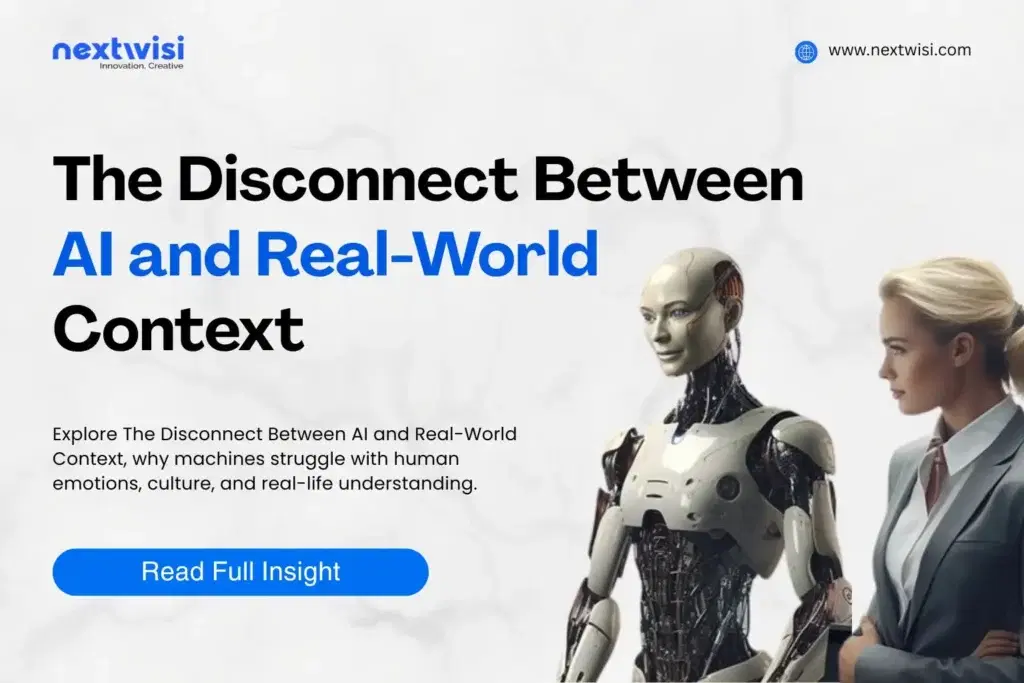
The 21st century has seen the advent of Artificial Intelligence that has become one of the most significant technologies in the history of the field, revolutionizing the industries, including healthcare and education, marketing, finance, entertainment, and scientific research. AI is able to create text, process large volumes of data, forecast trends, automate processes and can even create artwork and music. Even with these great feats, there is one important drawback, which has been an urgent limitation, AI does not perceive real-life situations in that depth, emotion, and meaning that human beings can.
Such a lack of connection between artificial intelligence and human experience begs a significant question: Can machines really comprehend meaning, emotion, cultural subtext, and lived reality or are they merely faking intelligence without really understanding it?
With the development of AI into more areas of human activity, it is necessary to fill this gap so that technology can serve humanity and not misunderstand it or oversimplify it.
AI is the best at information processing, detecting patterns, and responding to information on a probability and training data basis. Nonetheless, human intelligence is not limited to processing data because it encompasses emotional consciousness, personal experience, moral judgment, cultural consciousness, and intuitional judgment.
A machine is capable of recognizing emotional words such as love, pain or happiness, but becomes incapable of experiencing those emotions and knowing how they affect the person on a larger scale. Human beings, however, derive meaning based on the memory, relationships, failures, cultural forces and growth.
AI works with patterns, whereas humans perceive meaning and that is influenced by their life experience and emotional richness.
Real-life experiences that include relationships, and difficulties, success, loss, social interaction and cultural upbringing influence human understanding. AI is not alive, but just learns based on data and codes.
The emotional complexity, moral issues, social nuances, cultural symbolism, or the intuitive decision making of the human mind cannot be fully comprehended by the AI without practical experience in the context of a real life scenario.
Human language is overlapped with sarcasm, humor, metaphor, emotional undertones, historical allusions and cultural background. Information can be interpreted through a variety of tones, common knowledge, and understanding of the situation and not the words.
AI is capable of creating grammatically correct sentences, yet it often cannot process nuances, affective messages, or culturally-specific words or expressions that demand real-world knowledge.
Empathy, moral values, personal beliefs, emotional intelligence and social responsibility are some factors that make people make decisions. However, AI is based on logical rules, statistical models, and predetermined goals and is not based on actual ethical intuition.
This restriction is particularly important in such areas as those that need compassion, moral judgment and emotional awareness.
Artificial intelligence is able to process medical information, identify illnesses, prescribe medications and help a physician to make a diagnosis quicker. Nevertheless, they are not able to comprehend the anxiety of the patient, emotional distress, attitude to healthcare, and mental issues in their entirety.
The diagnosis might be technically correct, however, unless the diagnoser has a compassionate understanding and is able to provide an emotional reassurance, the patient to the practitioner may lose an enormous amount of trust and comfort.
AI-assisted learning technologies are able to customize the lesson to each student and his or her performance, yet they fail to realize the problem of motivation, learning anxiety, lack of creativity, difficulty in confidence, or emotional obstacle to success.
Education needs to be encouraged, inspired, emotionally supported, and mentored which are not fully achievable on machines.
The AI chatbots and virtual assistants can easily respond to the queries raised by customers but customers often feel frustrated when their feelings, frustrations or complicated issues are not understood or addressed.
People desire to be empathized with, reassured and talked to in a meaningful way, not the automated replies that seem to be mechanical or impersonal.
Credibility is a very key consideration in technology adoption. Users start doubting the quality of AI and its judgments when they receive cold, insensitive and generic responses.
Humans have a tendency to appreciate empathy, authenticity, moral consciousness, emotional intelligence and sincerity. Unless AI can prove these attributes, it will be viewed as effective yet insensitive and socially inept.
The AI systems should be steered by the values and emotional understanding of humans, as opposed to efficiency or automation objectives, to gain trust.
Even though AI is very effective in the field of automation, optimization and predictive analytics, human input is still essential in the spheres which demand ethical considerations and emotional intelligence, creative expression, leadership and cultural awareness.
AI can be used to process information, but it is up to humans to make decisions related to compassion, fairness, accountability, social impact, and moral responsibility.
The best future will not be when machines take over the human being, but a future where AI can improve on the decision making of the human beings as they will continue to be in the position of meaning and ethics.
Researchers and developers are labored to decrease the context gap of AI through developing more emotionally conscious and socially intelligent systems.
The major innovations geared towards enhancing contextual AI are:
As much as these technologies may be able to make people more responsive, there is always an aspect of empathy that can be given by humans due to the fact that empathy is not a mathematical way of responding to people, but rather an emotional way of approaching people.
Ethical issues are still increasing as AI is increasingly engaged in decision-making.
The development of responsible AI would involve the cooperation of engineers, psychologists, sociologists, educators, policymakers, and actual users to make certain that technology is in line with human values.
Human beings are special creatures with specific skills which cannot be learnt by machines despite the fast development of the technologies.
Information can be produced by AI, but wisdom, emotional appeal, and meaning are created by humans.
The lack of connection to reality that can be introduced by AI should not be regarded as a technological failure, however, it should serve as a reminder of what makes human intelligence so special.
Collaboration should take over replacement in the future of AI as machines are used to deal with speed and efficiency, and people offer empathy, judgment, creativity, and ethical direction.
Through technological advancement and human experience, the society can develop AI machines which will not only be productive but also add emotional depth, cultural sensitivity, and moral responsibility to the society.
The development of Artificial Intelligence is currently growing at an unprecedented rate, however, it alone cannot substitute the richness of human experience, understanding of emotions, and awareness of context.
On the one hand, machines are able to process data more than ever before, but lived experiences, depth of emotions, social bonding, and cultural meaning give true understanding.
This should not be aimed at making AI more human-like but to make humans still in the center of decision-making, creativity, empathic, and ethical accountability.
Ultimately, the level of advancement will not be determined by the level of knowledge of intelligent machines – but how prudently and humane human beings make it their business to direct them.