By admin
12/27/2025

The automotive sector is fast becoming dynamic, with the digital revolution transforming the way cars are designed, produced, and consumed. Conventional engineering approaches are failing to satisfy the increasing safety, sustainability, personalization, and automation requirements. Generative AI in the automotive industry has become a potent force in this change, as it allows manufacturers to access new intelligence, efficiency, and innovation.
Generative AI enables automotive firms to move to a level of predictive and creative systems rather than the reactive ones. This technology is transforming the way vehicles are developed, smart manufacturing, and autonomous mobility through massive dataset analysis and development of optimized solutions. With the heightening competition, generative AI is emerging as a strategic base of future-proofed automotive ecosystems.
Generative AI in automotive is defined as the advanced artificial intelligence systems that are able to generate new designs, simulations, and knowledge using the available data. These types of models are used in the automotive industry to process information that comes in the form of sensor data of the vehicle, design parameters, road conditions, and user behavior to come up with intelligent output.
Generative AI, unlike traditional automation systems, acts as a system that learns patterns and suggests optimal solutions. It allows automotive brands to innovate at an increased pace, cost less, and enhance product quality throughout the lifecycle of the vehicle. Generative AI is a core contributor to automotive digital transformation as cars continue to become more connected, intelligent, and digital.
One of the most demanding and important stages in the development of vehicles is their design. This is changed with the use of generative AI, which allows exploration of intelligent designs and optimization in a short period of time. Before the actual physical production, engineers are able to produce several design options, perform virtual tests, and optimize components.
With generative AI, automotive designers are able to:
This thinking will enable manufacturers to produce innovative vehicle designs that are quicker yet are as safe and of high quality.
Conventional prototyping is time-consuming and resource-intensive, as are physical tests. Much of this process is substituted by high-fidelity virtual simulations generated by generative AI. With the help of digital testing, automotive companies are able to test the crash behavior, thermal performance, and driving dynamics in the real world.
Generative AI allows manufacturers to find out defects at the very beginning and make effective design choices through sophisticated simulation. This does not only lower the cost of development but also guarantees that vehicles are able to match up to the regulatory and performance standards before they are allowed to be produced.
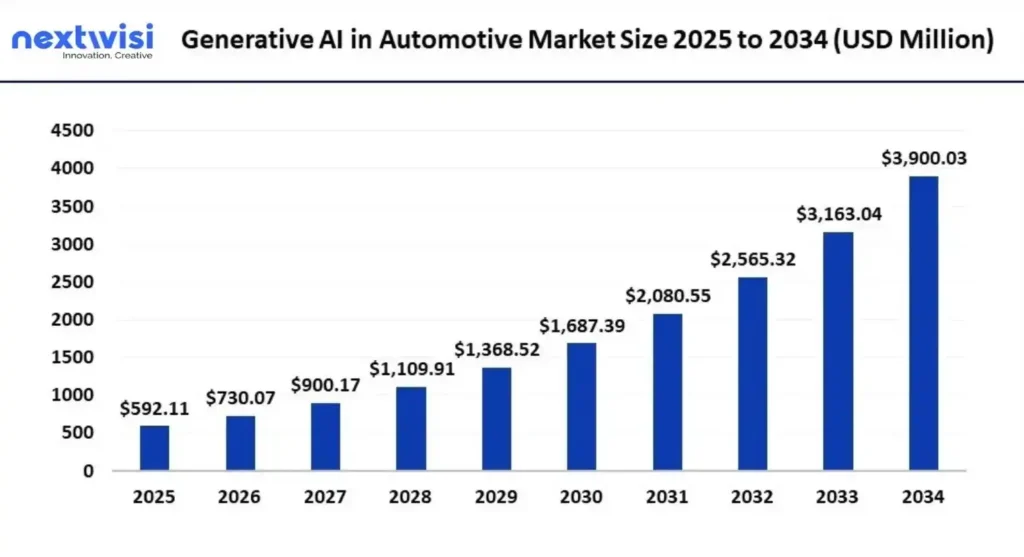
General AI has a significant beneficial impact on automobile manufacturing in terms of streamlining the processes and reducing the number of operational interruptions. Systems that are driven by AI process production data to predict equipment failure, enhance assembly performance, or minimize waste.
Generative AI is used in contemporary automotive manufacturing to:
These abilities assist the automakers in gaining stable production, enhanced dependability, and scaled production processes.
The automotive industry thrives on the power of data and uses it to generate AI. Car technology creates massive volumes of data through cameras, sensors, GPS technology, and software in the car. This raw data is converted by generative AI into actionable intelligence, which enhances the performance, safety, and customer satisfaction.
Through continuous learning with data, generative AI allows making predictive insights that sustain smarter vehicle behavior and more intelligent decision-making. This factual model enhances the base of related and smart automobiles.
The autonomous and intelligent mobility systems are the future of transportation. Generative AI is essential in the development of self-driving technologies in the way it improves perception, decision-making, and learning functions. Driving and operating in complex traffic, unpredictable situations, and varying driving conditions are some of the challenges that autonomous vehicles are expected to deal with.
Generative AI assists autonomous systems with the creation of synthetic training data, simulation of rare cases, and enhancement of the accuracy of the models. This results in safer navigation, increased obstacle detection, and more dependable driving performance. Consequently, autonomous mobility is more scalable and commercial.
The customer demands are now moving to very personalized customer automotive services. Generative AI allows car manufacturers to customize the features in vehicles according to the drivers.
Intelligent infotainment systems, adaptive navigation, and predictive maintenance warnings are just some of the ways generative AI contributes to user satisfaction at all touchpoints. One-on-one experiences are improving comfort as well as enhancing long-term customer loyalty and brand trust.
As vehicles become more connected, ensuring secure data exchange is critical. In advanced automotive ecosystems, blockchain development supports transparent and tamper-resistant data sharing across vehicle networks, enhancing trust and accountability in connected mobility environments.
The innovation in the automotive industry needs smart systems that may develop with the changing requirements. Strategic AI development enables automotive companies to deploy generative AI models where continuous learning, adaptation, and scaling are achieved on various platforms. This guarantees innovation in the long term, system reliability, and performance.
The latest automobiles are based on the digital infrastructure to enable real-time updates, diagnostics, and analytics. Advanced cloud solutions provide the scalability required to integrate generative AI seamlessly into connected automotive ecosystems, enabling continuous improvement and remote intelligence deployment.
Generative AI is reinventing the automotive value chain, including concept development to after-sales services. Having both intelligence and creativity will enable the manufacturers to create responsibly and fulfill the market needs in accordance with the changing market dynamics. Automobile brands investing in generative AI today will be in a better position to drive the mobility revolution of tomorrow.
Generative AI is revolutionizing the automotive sector through intelligent designing, efficient production, automatic movement of people, and individualized consumer experiences. Its capability to create smart insights and optimized solutions would form the foundation of automotive innovation in the future. Through the adoption of generative AI, automotive businesses will be able to create safer and smarter vehicles and more connected cars and facilitate sustainable development in the increasingly competitive market.