By admin
12/8/2025
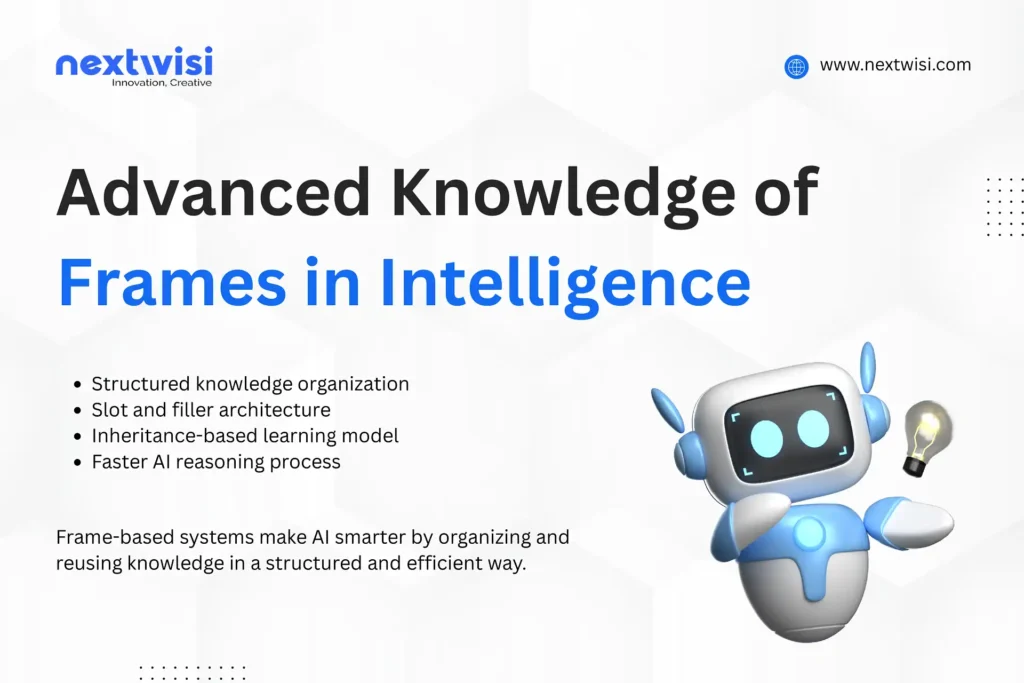
Artificial intelligence does not pertain to algorithms or machines , rather it pertains to the way knowledge is stored, structured, and utilized. Frames in artificial intelligence are one of the most effective and proven techniques of this kind. This idea can assist systems to arrange information in a manner that is close to how human beings think. In lieu of the knowledge-as-raw-data approach, the frames in artificial intelligence apply patterned structures to depict objects, situations, and relations.
Frames are also popular in knowledge representation, semantic network construction, and intelligent AI reasoning model development in real-world applications of artificial intelligence. They are critical in the contemporary intelligent systems because of their capability to generate a natural and human-like interpretation of data.
Frames in artificial intelligence are data representations that are tailored to describe objects in the real world in an organized manner. Every frame holds a set of pairs of attributes and values, with every attribute being stored in a container known as a slot and the related information as a filler.
This is referred to as a slot-filler structure and is the basis of most frame-based systems. Systems also assume reasonable information with the help of default values in frames that enable systems to provide reasonable information in the absence of data. This renders frames in artificial intelligence very adaptable and effective in the process of incomplete knowledge processing.
Structured frame-based representations of artificial intelligence facilitate object-oriented representation and thereby make it easier to describe computer-based models of AI to structure and process knowledge.
Frames have power in artificial intelligence in terms of their internal architecture. A frame is not a mere storage unit , it is a dynamic structure capable of supporting reasoning and learning.
Key building blocks include:
Enterprise-level AI/ML development is also designed using this design to enhance automation, prediction, and smart decision workflows.
As an example of frames in artificial intelligence, we will consider a simple example that is easy to grasp known as the frame of a car. In this part, I will demonstrate how the organized knowledge representation enables artificial intelligence systems to store, organize, and reason about real-world objects in a human manner.
In this model, a car is represented with the help of a slot-filler structure in which each slot signifies a property and each filler represents the real value.
Frame: Car
Brand: Tesla – The name of the manufacturer is stored, and the AI system can classify vehicles according to company, quality, and performance segment.
Model: Model S – Refers to the particular model of the car that assists the system in the comparison of features and specifications as well as their position in the market.
Color: Red – The color of the vehicle defines the visual look of the car and contributes to image recognition and tracking preference.
Engine Type: Electric – This refers to the source of power of the car. Reading the system will indicate to the user of the vehicle that it does not need fuel, but it needs to be charged.
Battery capacity: 100 kWh – Refers to the energy that can be stored in the car, which, as AI, is used to compute the driving range and charging times.
Charging Type: Fast Charging Supported – Indicates that the vehicle is capable of supporting the use of fast-charging stations, which allows the smart planning of routes and making of optimal charging choices.
Top Speed: 250 km/h – The highest possible performance of the car and can be used in the safety systems and also in performance comparisons.
Owner: Frame related to a person – Relates the car to a user profile, which can be handled by AI systems to administer identity, access, and customization.
With the assistance of this organized structure, artificial intelligence systems can be drawn to logical conclusions through frames. As an example, the system knows that the car has to be charged rather than refueled because the type of engine is electric. It is the way the AI reasoning models generate smart observations out of structured information.
Such structured models are also combined with the Cybersecurity solutions in the advanced systems to ensure secure identity and access frameworks.
Frames have a real-world application in various fields and technologies within artificial intelligence.
Frames assist the AI systems to comprehend the meaning of words by mapping them into organized concepts. These frames are interrelated via a semantic network, allowing one to understand them in a context. This enhances chatbots, search engines, and translation systems.
Applications of frames in artificial intelligence Frameworks in healthcare, finance, and engineering amount to expert system architecture, whereby domain knowledge is stored in an organized format. This aids in proper thinking and decision-making.
Frame-based systems are used to model objects, environments, and movement by the use of robots. Robots are capable of moving safely and carrying out the complicated tasks due to great knowledge representation.
These structures are commonly used with large-scale infrastructure platforms that utilize advanced cloud services to process frame-based knowledge at scale.
One of the greatest benefits of frames in artificial intelligence is inheritance. Frame inheritance will enable child frames to inherit the properties of their parent frames. This minimizes repetition and enhances uniformity.
For example:
The structure establishes a powerful hierarchy of inheritance, which improves logic-based representation and accelerates the process of system learning.
The same model is commonly deployed in the Ai Agent development, in which intelligent agents are based on inheriting basic behaviors and adapting them to particular tasks.
The child frame inherited by a single parent keeps a straight and simple hierarchy.
A frame can have the property of several parent frames and thus integration between domains can take place.
The child frames rework some of the parent frame attributes so that they can tailor behavior and better the conceptual modeling.
Both types enhance scalability and flexibility of frames in artificial intelligence.
There are numerous useful benefits of frames in the field of artificial intelligence:
Owing to these properties, frames can be used in artificial intelligence to enable the AI systems to make correct reasoning, carry out more rapid searches, and to make decisions more transparent.
Although frames are very effective in artificial intelligence, they are not without limitations:
Artificial intelligence Frame combining Semantic network models, and AI reasoning models can, however, relieve these constraints considerably.
Frames and ontologies have been compared in the context of modern representation of knowledge:
Frames:
Ontologies:
In short, they are mutually complementary and enhance the object-oriented representation and conceptual modeling of AI systems.
Frames in artificial intelligence are increasingly becoming relevant as AI advances. They are currently being integrated with machine learning, deep learning, and semantic web technologies. The artificial intelligence structure of frames enables AI to be more understandable, clear, and credible.
The frames in artificial intelligence are the basis of the structured decision-making in intelligent applications such as autonomous vehicles, intelligent assistants, and predictive analytics.
Artificial intelligence frames offer a knowledge representation system that is human-like, reliable, and structured. The information will be stored, processed, and reasoned efficiently using slots and fillers, attribute-value pairs, and inheritance hierarchy, which are available in AI systems.
The drawbacks of frames in artificial intelligence are outnumbered by the advantages despite their shortcomings. Frames can be used in conjunction with semantic networks, logic-based representation, and expert system architecture to develop scalable and intelligent AI systems.
As the AI world develops at an extremely fast pace, frames in artificial intelligence will continue to be a cornerstone method of constructing smarter, much more adaptive, and explainable intelligent machines.