By admin
12/6/2025
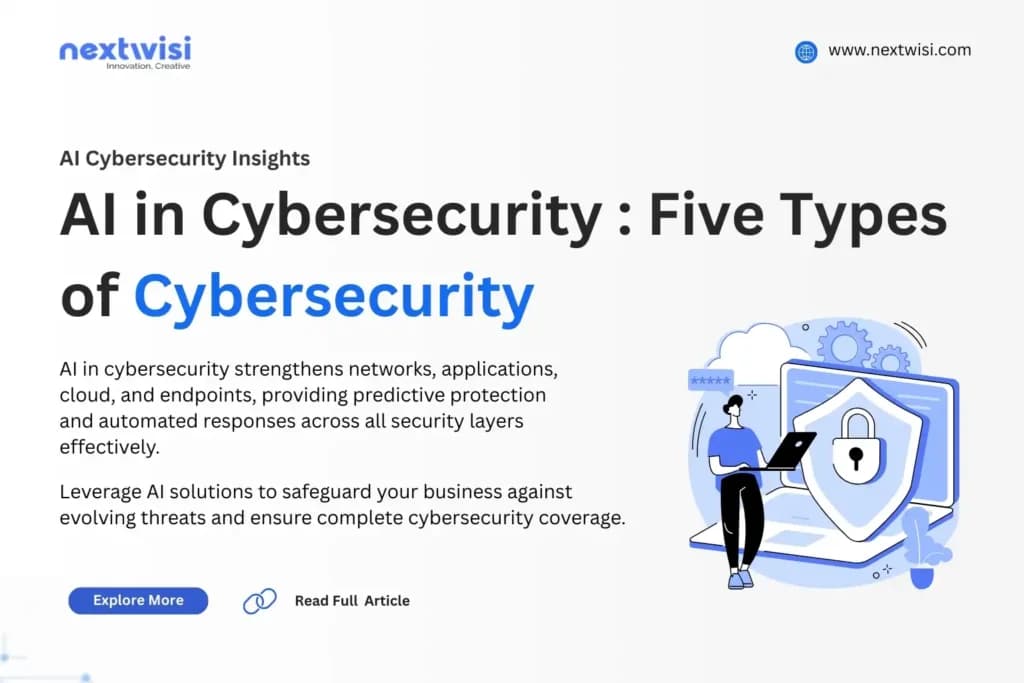
The digital transformation has brought immense opportunities, and at the same time, it has offered advanced cyber threats, which are constantly on the rise. Organizations are currently dependent on strong protection systems that address all the areas of digital infrastructure. The five general types of cybersecurity can help to develop the integrated system of defense that would safeguard networks, applications, data, cloud environments, and endpoints. Due to the novelty of ways in which cybercriminals can attack, AI in cybersecurity has become an essential element in offering automated, intelligent, and predictive protection of all digital layers.
AI in cybersecurity is a type of intelligent system that obtains knowledge through data and identifies patterns and threats and responds to risks, not depending on immediate human input. Such systems are based on technologies like behavioral analytics, anomaly detection, and machine learning-based classification models, which enable them to detect suspicious behavior much faster than conventional security tools.
Companies handling sensitive online processes usually use the opportunities of such technologies as blockchain development, which allows data transactions with tamper resistance to enhance transparency and trust. A much more resilient and secure digital ecosystem is created when applied to all five types of cybersecurity when it is combined with AI.
The necessity to develop AI appeared due to the increasing complexity of cyberattacks and their increasing automation level and the need to have security systems that can analyze the trends in large quantities within an amazingly fast time. Old-fashioned security technologies are not smart enough to identify unidentified or sophisticated attacks, but AI has the ability to identify hidden abnormalities that a human or outdated technologies often fail to notice.
Due to such developments, AI is now deeply embedded into all the five general types of cybersecurity to provide smarter and more powerful security.
Network security helps an organization protect inner networks against unauthorized access, data theft, mischief, or malicious use. It contains firewalls, intrusion detection systems, VPNs, and monitoring tools, but the current network is in need of much more sophisticated protection because the attack vectors and the complexity of networks are constantly being upgraded.
AI helps to increase network security, as it constantly examines real-time traffic and detects abnormal dynamics, which indicate the possible attack or suspicious activity of users. Monitoring systems powered by AI can detect malicious behavior much faster than a human and prevent malicious connections automatically before they can do any harm to the network, which is why network security is a necessary layer in the Five General Types of Cybersecurity.
The digital assets that are safeguarded by information security include documents, databases, personal information, and financial data, as well as secret business records. It aims at providing confidentiality, integrity, and data availability at every phase- storage, transmission, and access.
AI can help increase the level of InfoSec by monitoring the abnormal behavior of data, automatically categorizing sensitive data, and recognizing unauthorized access attempts to confidential resources. Smart data-security frameworks are frequently developed by companies with the solutions that AI/ML development teams develop to increase encryption strength, automatism in data protection, and elimination of internal or external data breaches.
Application security secures the software app against vulnerability attacks, coding errors, malware injections, API abuse, and data manipulation attacks. Applications are often the target of cybercriminals since they are vulnerable to sensitive information and access to backend systems.
To enhance the security of applications, AI is used to scan code in the development phase, test the application behavior, and detect the suspicious patterns in the running process. Millions of code lines can be analyzed by the AI tools, which have the ability to identify vulnerabilities that a human developer may overlook.
Cloud security is used to secure applications, data, and services based on cloud platforms like AWS, Google Cloud, and Azure. The complexity of cloud solutions is increasing as organizations move to cloud solutions, and this has created challenges such as identity management, misconfigurations, and unauthorized access risks.
To enhance security in the cloud environment, AI is used to analyze logs, identify suspicious cloud activities, prevent misconfigurations, and track identity activities to enhance protection in various environments.
The endpoint security defends individual user devices, like laptops, phones, tablets, servers, and IoT devices. Endpoints are common targets due to their direct connection to the networks, and the sites may not have sufficient security measures.
AI helps to improve endpoint security through EDR (Endpoint Detection and Response) systems that monitor the activities of devices, identify any malware patterns, and prevent any threats before they can propagate across the network.
The future of cybersecurity is being defined by AI, which introduces intelligence, automation, and predictive capabilities, which are not possible in traditional systems. The awareness of the five general types of cybersecurity, which are network, information, application, cloud, and endpoint security, assists organizations in coming up with better protection strategies. With the ongoing development of cyber threats, AI-based defense systems will play a crucial role in protecting safe, secure, and reliable digital operations in the global arena.