By admin
1/5/2026
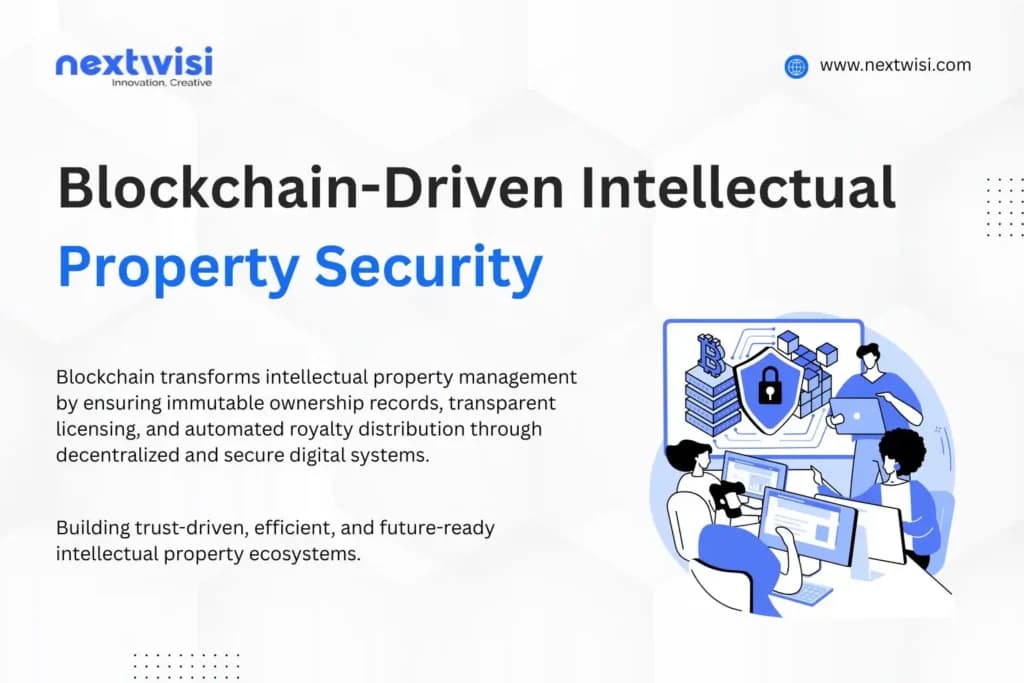
With a more digital and innovations-driven economy, intellectual property has turned out to be one of the most valuable assets to both individuals and enterprises. Nevertheless, the traditional intellectual property systems are usually caught up by the issues of sluggish registrations, claim of ownership, lack of transparency and high enforcement expenses. Blockchain in Intellectual Property proposes a new paradigm applicable to these issues, which will solve them with the help of decentralization, transparency, and impartiality.
With the use of blockchain technology, artists, companies, and the legal system can create a reliable, irreversible, and universal intellectual property management system. This change is transforming the way intellectual property is developed, authenticated, barred and enacted within industries.
The increasing use of Blockchain in Intellectual Property is supported by the fact that it generates trust in the digital space where ownership and unauthorized use of property is widespread. In contrast to centralized databases, blockchain stores records in more than one node, which means that no one can change or manipulate the data.
This decentralized system allows stakeholders to check the ownership of IP immediately, simplify the processes of licensing and minimize the reliance on intermediaries, which makes the administration of IP more effective, transparent, and safe.
The principles of blockchain technology present the core advancements that address the years of inefficiencies in the traditional IP framework. It can do much more than record-keeping since it can be automated, make it visible, and decentralized.
Key contributions include:
Among the most effective advantages of blockchain, one should mention the possibility to grant unquestionable evidence of ownership. When intellectual property is stored on the blockchain it is assigned a permanent digital token that indicates its presence at a particular point in time.
This unalterable history can also enable inventors, creators and organisations to demonstrate originality, to fight back infringement allegations and to settle any case more effectively by providing evidence of blockchain-based transactions that can be verified in a court of law.
The transfer of ownership under patents, trademarks and copyright may be complicated especially when preparing deals to merge, acquire or license out. Intellectual Property Blockchain eases these procedures by having a transparent and ever-updating ledger of ownership.
Any change of ownership would always be documented, thus making the due diligence faster, less litigation risk, and the access to the same verified information would be made available to all parties involved in the transaction lifecycle.
The conventional intellectual property is a system that heavily depends on centralized structures to assist in registration, validation and enforcement. This tends to cause delays, increased expenses, and lack of control in creators. Blockchain comes with a decentralized approach that vests the ownership power squarely in the hands of IP owners.
Removing middlemen allows blockchain to achieve quicker registrations, enhanced visibility, and enhanced agency over creators and a high level of data integrity and security.
The traditional methods of licensing intellectual property deal with complicated contracts, slow royalty payments, and compliance checks that are done manually. Intellectual Property Blockchain reinvents this process by automating the workflow of licensing by use of smart contracts.
Blockchain-powered licensing benefits include:
Blockchain development at advanced stages is very important in the construction of the customized intellectual property that is specific to the industry. These platforms facilitate secure IP registries, auto-workflow, decentralized marketplace, and NFT integrations.
Organisations are able to develop IP ecosystems based on scalable blockchain development frameworks that meet regulatory requirements, enhance the effectiveness of operations, and facilitate future innovation in global markets.
Through tokenization, intellectual property can be digitized into a token or alternatively known as non-fungible token (NFT) on the blockchain. This innovation within Blockchain in Intellectual Property creates new opportunities for monetization and ownership flexibility.
IP NFT opens up possibilities of fractional ownership, trading more easily worldwide, increasing liquidity, and better monitoring of unlicensed use, especially in the creative sector (art, music, games, and digital media).
A large number of IP solutions, which run on blockchain, use cloud services to guarantee a high availability, performance optimization and scalability. Cloud infrastructure helps to maintain the smooth access to data, off-chain storage, and resilience of the systems.
With the combination of cloud services and blockchain network, organizations have a balanced architecture where IP safety is guaranteed without compromising speed, elasticity, and economical scale.
A number of organizations have managed to use blockchain to modernize intellectual property management. The creators use tools such as Blockai to safeguard digital property using the blockchain method of creating time stamps that cannot be used to violate copyright.
Verisart offers digital certificates that are digital proofs of ownership of artworks and luxury goods, which allow the creation of non-fungible tokens and eases the process of authenticity verification. Bernstein provides certified version histories, which track the history of innovation development and have a transparent ownership history.
These practical applications show the usefulness of the Blockchain in Intellectual Property in industries.
The distributed ledger of blockchain will make sure that all the legitimate parties have access to the same verified information at the same time. This openness enhances confidence between creators, licensees, regulators and enterprises.
A single and auditable IP transaction record can minimize conflicts, enhance cooperation, and hold the whole intellectual property ecosystem accountable by the blockchain.
Custom app development plays a vital role in making blockchain-based IP solutions accessible to non-technical users. Intuitive applications enable the creators and businesses to register IP assets, license and keep track of royalties in an efficient manner.
IP management tools make blockchain infrastructure usable and user friendly, closing the divide between complex blockchain infrastructure and daily operational requirements, and are used and adopted across industries.
Despite its transformative potential, Blockchain in Intellectual Property faces adoption challenges. Legal ambiguity, standardization, interoperability and complicated system integration are still a great hurdle.
Moreover, the implementation of blockchain-driven IP rights in different jurisdictions needs regulatory clarity, cooperation across the borders, and consistency between the regulations and the new technologies.
The World Intellectual Property Organization (WIPO) also encourages the use of blockchain by offering task forces, pilot projects, and global standardization projects. These are the attempts to coordinate the use of blockchains in international IP systems.
The intervention of WIPO underscores the increasing institutional trust in blockchain as an underlying technology to the future of intellectual property management.
The adoption of blockchain in IP by organizations should consider a proper choice of suitable platforms, designing secure smart contracts, encryption of sensitive data, and cooperation with qualified and experienced legal and technical partners.
A compliance-based strategic approach makes blockchain-based intellectual property systems scalable, secure, and valuable in the long run.
Intellectual Property Blockchain is revolutionizing the process through which IP rights are generated, secured and monetized. Blockchain is a solution to these significant flaws of the traditional IP system by providing immutable records, decentralization, tracking ownership transparently, and automatic issuance of licenses.
With the development of blockchain and cloud services, as well as the creation of applications, the introduction of blockchain into intellectual property management is going to grow at a faster rate, and the world will have a secure, efficient, and future-ready basis of protecting intellectual property.