By anil
11/21/2025
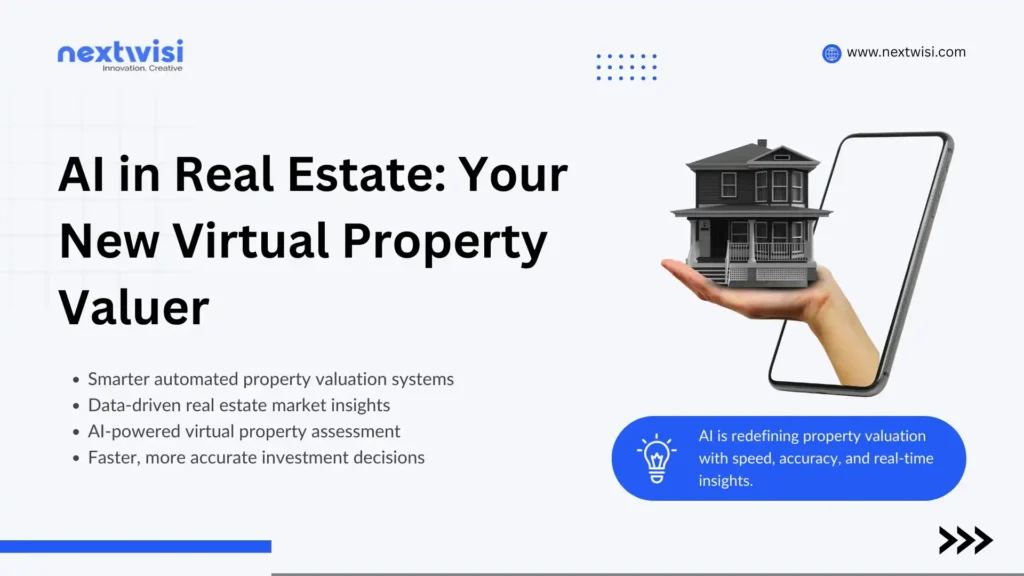
Artificial intelligence is transforming the property ecosystem of the world, and the change is occurring at a rapid rate that no one would have thought. AI in Real Estate: Your New Virtual Property Valuer is now forming the backbone of the new valuation models, and this is accurate, fast, and gives real-time market insight. As automation and predictive analytics are only getting better each year, AI is making buyers, sellers, investors, and agencies intelligent in their decision-making.
The use of AI to provide property valuation services can process several thousand data points, such as market history, neighborhood quality, property properties, buyer demand, and economic trends. These sophisticated systems eliminate guesswork in older methods of valuation and provide more open and data-supported results. Consequently, the digitalization of valuation is no longer an option but a necessity for contemporary real estate companies.
Conventional valuation of property relied extensively on manual inspection, experience, and availability of limited data. Nowadays, AI systems conduct a thorough analysis in several seconds. Price accuracy is made more precise with the capability of AI in real estate: Your new virtual property valuer to compute vast numbers of data clusters brings about greater accuracy.
These are based on machine learning, predictive analytics, the use of geospatial technology, and computer vision to read property images, read past trends, and predict future value. In homes and the business world, AI makes sure that the estimation is updated and even more dependable and devoid of human error.
AI technology also saves on time wastage in running real estate agencies. Professionals can now get instant reports with an added layer of market intelligence, neighborhood indicators, and projected rates of appreciation instead of spending hours gathering data or making comparisons in the property listing. This will allow clients to make sure choices and enhance the trustworthiness of the real estate firms.
The use of predictive modeling and automated valuation instruments has altered the manner in which properties are valued. AI analyzes property photos, surroundings, interior, and suchlike listings to ascertain the precise value of a property in the market.
These benefits enhance valuation accuracy as well as enhance transparency to buyers, sellers, and investors. Firms that adopt AI enjoy improved customer satisfaction, reduced pricing conflict, and hassle-free transactions.
The emergence of AI dashboards has begun to be applied by modern real estate companies to monitor the dynamics of the market in real time. These systems are integrated by deep learning, geospatial data, and historical price movements, which provide accurate predictions. In the case of AI in real estate, the agents will be able to know the future prices of houses, the areas where they could make a profit by investing, and the patterns of buyer behaviors.
Image recognition technology based on AI is also an important factor. It is able to identify the condition of a property, remodeling, and structural or visual improvements that directly affect the pricing. This mode of analysis through images is more elaborate compared to the conventional face-to-face analysis.
The AI-based forecasting instruments also assist investors in evaluating the amount of risk, rental returns, and the market dynamics. Such sophisticated inputs exclude making wrong decisions when investing in a property, and users are also assured of how a property could perform in the future.
The real estate providers are adopting smart automation to automate processes and provide quick and precise services. The insight section is structured and has 4 detailed points, as specified in your format rule:
Such improvements enable real estate organizations to enjoy a competitive edge in the process of delivering excellent services to customers.
In addition to simple valuation, AI incorporates deep learning models, economic metrics, and AI/ML development techniques to research property potential. Such insights will enable the developers, the investors, and the agencies to be more intelligent about their plans and make them more profitable.
The AI systems follow thousands of datasets, such as development of infrastructure, criminal patterns, price appreciation cycles, and socio-economic transformations and These datasets act like structured information sets in machine learning, helping AI understand neighborhood evolution. This provides real estate decision-makers with a profound sense of the way in which an area is going to look in the future. This kind of intelligence could not be achieved before using manual ways of evaluation.
The developers of real estate can gain access to AI-based demand forecasting. They are able to make predictions of the type of property that will be the best in a particular area before they roll out the project, be it luxury flats, business units, or rental apartments. The AI risk models are also used by the investors to predict long-term returns and to avoid buying assets that are overvalued.
Artificial intelligence robots, smart valuation engines, and robots are now integrated into nearly every aspect of the real estate process. Those technologies will minimize errors, enhance customer support, and make operations more efficient.
These applications make customer experiences and operational accuracy higher.
The initial use of intelligent automation in real estates will give an advantage over competitors in the sphere of pricing accuracy, customer experience, and workflow speed Businesses that adopt AI early or work with an expert AI Ml development company can achieve better pricing accuracy. Your New Virtual Property Valuer AI in Real Estate is the combination of accuracy, data science, and predictive intelligence in the industry.
Machine learning and deep learning technologies will be developed further, and the valuations will be more accurate. Visual analysis tools, combined with behavioral predictors and geospatial mapping tools, will be the norm across property portals. Business people will have more visibility in prices, investors will have a greater influence on risk, and agencies will offer quick services based on data.
Many companies collaborate with a professional AI agent development company to integrate advanced automation into their systems.
Through AI, the real estate works are being redefined by removing uncertainty and making smarter decisions. AI in real estate is reshaping the property ecosystem by delivering more accurate valuations, stronger data transparency, and smarter decision-making. AI improves every aspect of the real estate process, starting with its valuation accuracy, fraud detection, and individualized suggestions.
Those who embrace intelligent automation in the present day will experience better performance, increased speed, and customer trust in the future. And to businesses that require high-end AI transformation, Nextwisi Solutions offers business-driven, future-perfect AI development solutions aimed at transforming real estate operations in a more precise, automated, and scalable manner.